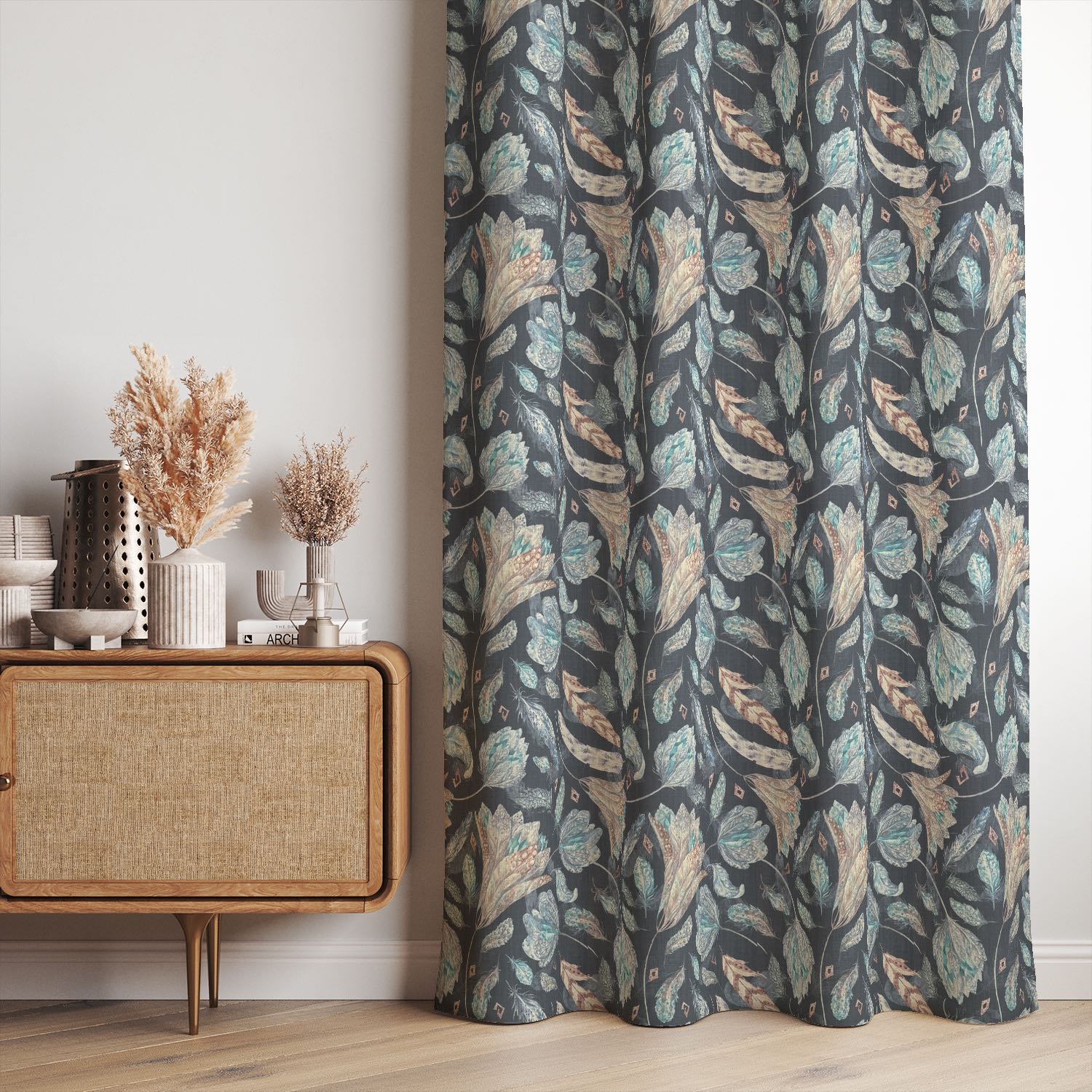
The best curtain fabric pattern depends on the size of the window, the scale of the design and whether the curtains should be the room's focal point or a quieter background. Large florals, leaves and art deco motifs work particularly well across tall drops, while stripes, checks and smaller repeats suit compact windows and Roman blinds.
Pattern should be considered alongside fabric weight, width, lining and repeat. A design that looks small on screen may become much more dominant when repeated across a pair of full-length curtains, so always order a sample.
Reviewed and updated by The Millshop Online fabric team: August 2026.
Curtain pattern comparison
| Pattern | Typical effect | Works particularly well for | Check before ordering |
|---|---|---|---|
| Floral | Soft, traditional or dramatic | Bedrooms, living rooms and country interiors | Motif scale and vertical repeat |
| Stripe | Ordered, smart or relaxed | Full curtains, blinds and coastal schemes | Stripe direction and alignment |
| Leaf or botanical | Natural and contemporary | Living rooms, garden rooms and bedrooms | Colour balance and repeat size |
| Bird or nature print | Decorative and characterful | Feature windows and reading rooms | Placement of prominent motifs |
| Art deco or geometric | Structured and statement-led | Modern, formal and period-inspired rooms | Symmetry and matching across widths |
| Check or ticking | Classic and easy to coordinate | Cottages, kitchens, bedrooms and blinds | Keeping lines square during making |
Explore the full curtain fabric collection and compare the product width, pattern repeat and recommended uses.
How pattern scale changes a room
- Small-scale patterns create texture from a distance and are easier to use on compact windows, blinds and cushions.
- Medium-scale patterns are versatile for most domestic curtains and give enough detail without dominating the room.
- Large-scale patterns become a feature and need enough uninterrupted fabric to show the design properly.
Window size is not the only factor. A large pattern can make a small room feel intentional when the rest of the scheme is restrained, while a tiny repeat may look busy across a very wide curtain. Use a full-size sample and step back from it before deciding.
Floral curtain fabric
Floral fabric ranges from small country flowers to large painterly blooms. Muted florals on linen or linen-look basecloths create a softer scheme, while saturated and multicoloured designs make the curtains the main feature.
Large florals suit full-length curtains because the repeat has room to develop. Smaller florals work well for bedrooms, cottages and Roman blinds. Check whether a prominent bloom should be centred within each curtain.
Striped curtain fabric
Striped fabric can feel formal, coastal, country or contemporary depending on its width and colour. Vertical stripes emphasise height, while ticking and woven stripes create a more relaxed appearance.
Confirm whether the stripe runs along the roll or across it. Lines need accurate alignment at seams, hems and blind edges, so a small cutting error can be more visible than it would be on an irregular print.
Leaf and botanical curtain fabric
Leaf and botanical fabric brings movement and a natural reference without always feeling as traditional as floral print. Green and blue designs create a calm scheme, while ochre, pink and multicoloured botanicals give a warmer or more playful result.
Botanical curtains coordinate easily with plain upholstery and textured cushions. Repeat one or two colours elsewhere in the room instead of matching every item to the full print.
Bird and nature-inspired fabric
Bird fabric creates a decorative, individual window treatment. Depending on the drawing style, it can suit heritage rooms, country interiors or colourful contemporary schemes.
Look carefully at motif direction. Birds, animals and branches can have an obvious top and bottom, which affects cutting, Roman blind orientation and the amount of usable fabric.
Art deco and geometric curtain fabric
Art deco fabric uses fans, arches, scallops and ordered geometry to create a structured appearance. It pairs well with velvet, dark woods, plain fabrics and jewel colours.
Geometric designs highlight alignment, so plan seams and pattern placement before cutting. A symmetrical motif may require additional fabric if it needs to be centred on each curtain or blind.
Pattern repeat and matching
The vertical pattern repeat is the distance before the design begins again down the roll. When several fabric widths are joined, every cut drop is normally rounded up to a full repeat so the design aligns across the finished curtain.
A large repeat therefore uses more fabric than a plain design for the same window. Half-drop and offset repeats require additional planning. Use our curtain fabric calculator guide to see the calculation with a worked example.
How to choose pattern colour
Start with the colours that will remain in the room: flooring, walls and major furniture. A multicoloured print can connect several existing shades, while a two-colour pattern gives a cleaner and more controlled result.
- Blue and green often create a calm, natural scheme.
- Pink, ochre and yellow introduce warmth and energy.
- Dark outlines add definition and can make a print feel more structured.
- Neutral space within a pattern can stop a large design feeling overwhelming.
View the sample in daylight and artificial light because colour and contrast can change substantially after sunset.
How to coordinate patterned curtains
- Choose the curtain fabric as the main pattern.
- Pull one or two colours from it for walls, cushions or upholstery.
- Use plains and textures on large nearby surfaces.
- Repeat a smaller related pattern only where the scales are clearly different.
- Avoid placing several designs of the same scale next to one another.
Curtains and upholstery do not need to match exactly. Using the curtain pattern once and repeating its colours elsewhere usually produces a more flexible room.
Patterned curtain fabric buying checklist
- Order a sample and assess the true motif scale.
- Check the fabric width and vertical repeat.
- Identify the top, bottom and direction of the design.
- Allow for matching and centring.
- Choose the heading and lining before calculating metreage.
- Confirm curtain or Roman blind suitability.
- Use the curtain fabric buying guide for the full specification check.
Frequently asked questions
Do large curtain patterns make a small room look smaller?
Not automatically. One large, well-chosen pattern can create a clear focal point. The surrounding colours, contrast and amount of other pattern usually matter more than the room size alone.
Are stripes difficult to make into curtains?
They require accurate cutting and alignment because errors are visible along the straight lines. Confirm the direction and allow enough material for matching.
Which pattern is best for Roman blinds?
Small and medium repeats are straightforward, but a large motif can also work when centred carefully. Consider how the design appears with the blind both lowered and folded.
How much extra fabric does pattern matching need?
The amount depends on the vertical repeat and the number of cut widths. Each cut drop may need to be rounded up to a complete repeat.
The best curtain pattern is one whose scale, direction and colour work across the whole window. Sample it at full size, calculate the repeat accurately and coordinate it with quieter fabrics elsewhere in the room.